
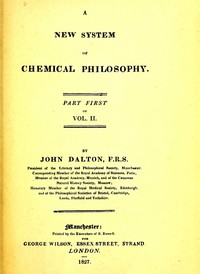
A new system of chemical philosophy, Volume 2, Part 1 by John Dalton
Let's be clear from the start: this is not a book with a plot in the traditional sense. There are no heroes, villains, or love triangles. The 'story' here is the story of an idea fighting to be born.
The Story
Imagine the scientific world in the early 1800s. Chemistry is a messy collection of observations without a clear, unifying rulebook. In walks John Dalton, a quiet English teacher and meteorologist. In this volume, he's not just hinting at his big idea—he's building the whole case. He systematically argues that every element is made of unique, indestructible atoms. He proposes that these atoms have specific weights, and that chemical reactions are just these little balls rearranging themselves. He uses evidence from gases, from how elements combine in fixed ratios, to slowly and methodically construct his argument. The 'narrative' is his logical march from observation to revolutionary conclusion.
Why You Should Read It
Reading Dalton is like getting a backstage pass to a moment that changed everything. You see the gears turning. It's raw, foundational science. He's not always perfectly right by today's standards, and that's what makes it fascinating. You witness the birth of a concept so fundamental we now take it for granted. It's humbling and exciting. You're not just learning what the atomic theory is; you're seeing how it was argued into existence against the tide of accepted wisdom. It turns abstract science into a very human act of persuasion.
Final Verdict
This is a niche read, but a powerful one. It's perfect for science lovers, history buffs, or anyone curious about how big ideas take root. Don't go in expecting a page-turner. Go in expecting to sit with a brilliant, meticulous mind as it lays the groundwork for the modern world. If you've ever wondered what the original arguments for atoms actually sounded like, this is your primary source. It's a challenging but deeply rewarding look at a cornerstone of human knowledge, straight from the mason who laid it.
This text is dedicated to the public domain. It serves as a testament to our shared literary heritage.
Matthew Miller
1 year agoThe balance between academic rigor and readability is perfect.
Susan Martinez
11 months agoI took detailed notes while reading through the chapters and the attention to detail regarding the core terminology is flawless. A trustworthy resource that I'll keep in my digital library.
Nancy Hernandez
9 months agoHaving read the author's previous works, the author clearly has a deep mastery of the subject matter. I am looking forward to the author's next publication.

Robert Lopez
2 years agoThe clarity of the concluding remarks is very professional.