
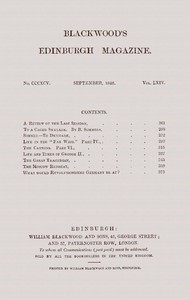
Blackwood's Edinburgh Magazine, Vol. 64, No. 395, September, 1848 by Various
Don't go into this expecting a novel. Blackwood's Edinburgh Magazine was a monthly miscellany, a powerhouse of 19th-century thought and entertainment. This September 1848 issue lands right in the middle of the 'Year of Revolutions.' France had overthrown its king, empires were shaking, and everyone was arguing about what came next. The 'plot' here is the collective mind of Britain's literate class grappling with that reality.
The Story
There isn't one story, but many voices in conversation. You might find a detailed, almost nervous, analysis of the French political situation. Next, a travel piece describing the rugged beauty of the Scottish Highlands or a far-flung colony, offering an escape or a reminder of British strength. Then, you'd flip to the latest installment of a serialized novel—a sensation story full of mystery or romance, providing the pure fun that readers craved alongside the heavy politics. It's a curated slice of a month's reading, where hard news sat beside leisurely fiction.
Why You Should Read It
The magic is in the immediacy. History books tell you what happened; this shows you what it felt like while it was happening. The writers aren't historians with perfect hindsight; they're commentators, novelists, and explorers trying to predict the next day's headlines. Reading their takes—some brilliant, some biased, all passionate—is incredibly human. You see the birth of modern journalism and political commentary, raw and unfiltered. The serialized fiction pieces are a bonus, showing the pure craft of storytelling designed to keep subscribers hooked for the next issue.
Final Verdict
This is for the curious time-traveler. Perfect for history lovers who want to move beyond textbooks and eavesdrop on the past, or for literature fans interested in how serialized stories worked. It's also great for anyone who enjoys magazines like The Atlantic or Harper's today; this is their great-great-grandparent. It requires a bit of patience for the older style, but the reward is a direct, unmediated connection to a world in profound crisis and change. You're not just learning about 1848; you're spending a few hours in it.
You are viewing a work that belongs to the global public domain. It is now common property for all to enjoy.
Lucas Smith
1 year agoThis is one of those stories where it challenges the reader's perspective in an intellectual way. Definitely a 5-star read.

Elijah Flores
1 year agoBeautifully written.