
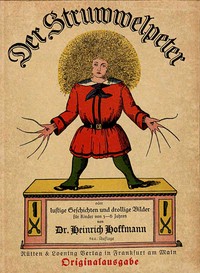
Der Struwwelpeter by Heinrich Hoffmann
First published in 1845, Der Struwwelpeter (Shock-headed Peter) isn't one story but a series of ten short, rhyming tales. Each one focuses on a child who commits a specific misdeed and suffers an exaggerated, often grotesque consequence. The book opens with the titular Struwwelpeter, a boy so neglectful of his grooming that his hair stands on end and his fingernails are monstrous. From there, we meet a parade of poorly behaved kids: there's Fidgety Philip, who wrecks a dinner by tipping over the table; Harriet, who plays with matches and is reduced to a pile of smoldering shoes; and Johnny Head-in-Air, who walks while staring at the sky and falls into a river. The most infamous story is The Story of Little Suck-a-Thumb, where a boy named Conrad ignores his mother's warning and has his thumbs chopped off by a giant, scissor-wielding tailor.
Why You Should Read It
This book is a cultural time capsule. Reading it today feels like uncovering a secret, slightly disturbing corner of childhood's past. The shock value is undeniable—these tales are meant to scare kids straight, and they do it with a bizarre, almost cartoonish violence that's hard to look away from. But beyond the grim lessons, there's a strange charm in Hoffmann's energetic rhymes and his wonderfully detailed, expressive illustrations. He drew them himself, and they're full of life and dark humor. You can feel his frustration with the boring, preachy children's books of his time and his desire to make something that would actually capture a child's attention, even if it gave them nightmares. It makes you wonder about the line between effective caution and pure trauma, and how ideas about parenting have changed.
Final Verdict
This isn't a book for young children (unless you want to explain some very complex emotional fallout). It's perfect for readers curious about the history of children's literature, fans of dark folklore and fairy tales, or anyone who enjoys a macabre slice of social history. Approach it not as a manual for child-rearing, but as a fascinating, darkly comic artifact. Think of it as the great-great-grandfather of Roald Dahl's nastier moments or Lemony Snicket's unfortunate events. It's a quick, unforgettable read that will make you gasp, chuckle uncomfortably, and be very glad you grew up in a slightly more forgiving era.
This digital edition is based on a public domain text. Feel free to use it for personal or commercial purposes.
Steven Robinson
2 years agoGreat digital experience compared to other versions.








Aiden Taylor
5 months agoA bit long but worth it.