
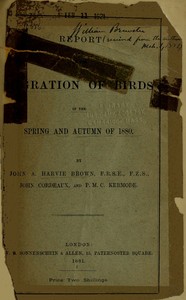
Report on the Migration of Birds in the Spring and Autumn of 1880. [Second…
Let's clear something up first: if you're looking for a novel with a plot twist on page 200, this isn't it. But if you're curious about a different kind of story—a real one—then pull up a chair.
The Story
The 'story' is deceptively simple. In 1880, a man named Philip Kermode committed to a year-long project on the Isle of Man. His goal? To observe, record, and try to understand the comings and goings of migratory birds. The book is structured as his formal report, detailing species, numbers, dates, and weather conditions. But between the lines of data, you see the narrative of the year itself: the slow build of spring, the frantic activity of autumn, the days of empty skies and disappointing counts. The 'characters' are the birds—the swallows, the fieldfares, the golden plovers—and the lone, dedicated observer trying to decode their schedules.
Why You Should Read It
I loved this book for its quiet intensity. Kermode's voice is measured and professional, but his dedication is absolute. You feel his frustration on days when fog obscures everything, and his small triumphs when he confirms a pattern. It made me look at the sky differently. That V of geese in fall? Someone like Kermode once sat and carefully counted, wondering where they came from and why. The book is a powerful reminder of how much effort and passion went into building our basic understanding of nature, piece by patient piece. It turns a scientific exercise into a kind of meditation on attention.
Final Verdict
This is a niche read, but a rewarding one. It's perfect for anyone who enjoys natural history, slow non-fiction, or biographies of obscure passions. Think of it as the literary equivalent of birdwatching: it requires you to slow down and focus, and the reward is a profound sense of connection to a specific place and time. If you liked Robert Macfarlane's work or Helen Macdonald's H is for Hawk, you'll appreciate the careful, observant heart at the center of this old report. Just don't expect any car chases.
This publication is available for unrestricted use. Share knowledge freely with the world.
Donald Perez
1 year agoExactly what I was looking for, thanks!
Paul Smith
4 months agoA sophisticated analysis that fills a gap in the literature.
Karen Taylor
2 months agoAs a professional in this niche, the transition between theoretical knowledge and practical application is seamless. A perfect balance of theory and practical advice.
Mary White
6 months agoMy first impression was quite positive because the practical checklists included are a great touch for real-world use. I'm glad I chose this over the other alternatives.








Mary Johnson
9 months agoIf you're tired of surface-level information, the way it challenges the status quo is both daring and well-supported. Simple, effective, and authoritative – what else could you ask for?