1

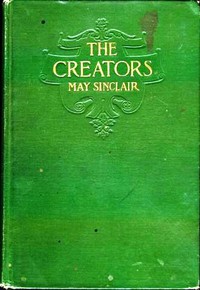
The Creators: A Comedy — A Closer Reading
(0 User reviews)
488
Project Gutenberg
2008
Not confirmed
Authors -- Fiction; Authorship -- Fiction; Man-woman relationships -- Fiction
Readers of public-domain and historical texts
Project Gutenberg digital edition
en
Edition facts
Words
158,911
Reading time
691 min
Text sections
16
Before opening The Creators: A Comedy — A Closer Reading, the edition data offers a quick orientation: 158,911 words, 11 hr 31 min estimated reading time, and 16 detected text sections.
The text analysis averages about 11.9 words per sentence, while the detected sections provide another way to judge how the source is divided.
Project Gutenberg metadata also associates the work with “Authors -- Fiction,” connecting these edition facts with the source record’s subject description.
Source:
Project Gutenberg record #25971
May Sinclair's novel examines the creative drive and its costs through the intersecting lives of writers Jane Holland, George Tanqueray, and Nina Lempriere, set against a backdrop of social expectations and personal sacrifice.
Editorial Edition Score
4.8/5
★★★★★
★★★★★
Calculated from edition completeness, EPUB availability, text structure and catalogue metadata. Not a user rating.
How this score is calculated
- Description quality20 pts
- Title & short description10 pts
- Source metadata20 pts
- Text length15 pts
- Chapters / structure15 pts
- EPUB file integrity20 pts
Total of 100 points, scaled to a 2.5-5.0 range. Editions with an empty description or a missing EPUB file are not scored.
Edition quality
Read the Text
She had wrung it from him, the thing that six days ago he had come to her to say.
It was Jinny who lay there, Jinny, his wife.
"Ah," she cried, "try not to hate me!"
"George," she said ... "I love you for defending him"
She closed her eyes, "I'm quite happy"
Jane stood in the doorway, quietly regarding them.
Three times during dinner he had asked himself what, after all, was he there for? And at the end of it, as she rose, her eyes held him for the first time that evening, as if they said that he would see.
She had put him as far from her as possible, at the foot of her table between two of the four preposterous celebrities whom she had asked him, George Tanqueray, to meet.
Everything, except her eyes, had changed since he had last dined with Jane Holland, in the days when she was, if anything, more obscure than he. It was no longer she who presided at the feast, but her portrait by Gisborne, R.A. He had given most of his attention to the portrait.
Gisborne, R.A., was a solemn egoist, and his picture represented, not Jane Holland, but Gisborne's limited idea of her. It was a sombre face, broadened and foreshortened by the heavy, leaning brows. A face with a straight-drawn mouth and eyes prophetic of tragedy, a face in which her genius brooded, downcast, flameless, and dumb. He had got all her features, her long black eyebrows, her large, deep-set eyes, flattened queerly by the level eyebrows, her nose, a trifle too long in the bridge, too wide in the nostril, and her mouth which could look straight enough when her will was dominant. He had got her hair, the darkness and the mass of it. Tanqueray, in his abominable way, had said that Gisborne had put his best work into that, and when Gisborne resented it he had told him that it was immortality enough for any one to have painted Jane Holland's hair. (This was in the days when Gisborne was celebrated and Tanqueray was not.)
If Jane had had the face that Gisborne gave her she would never have had any charm for Tanqueray. For what Gisborne had tried to get was that oppressive effect of genius, heavily looming. Not a hint had he caught of her high levity, of her look when the bright devil of comedy possessed her, not a flash of her fiery quality, of her eyes' sudden gold, and the ways of her delicate, her brilliant mouth, its fine, deliberate sweep, its darting tilt, like wings lifted for flight.
When Tanqueray wanted to annoy Jane he told her that she looked like her portrait by Gisborne, R.A.
They were all going to the play together. But at the last moment, she, to Tanqueray's amazement, threw them over. She was too tired, she said, to go.
The celebrities pressed round her, voluble in commiseration. Of course, if she wasn't going, they wouldn't go. They didn't want to. They would sacrifice a thousand plays, but not an evening with Jane Holland. They bowed before her in all the postures and ceremonies of their adoration. And Jane Holland looked at them curiously with her tired eyes; and Tanqueray looked at her. He wondered how on earth she was going to get rid of them.
She did it with a dexterity he would hardly have given her credit for. Her tired eyes helped her.
Then, as the door was closing on them, she turned to him.
"Are you going with them," she said, "or will you stay with me?"
"I am certainly not going with them----" He paused, hesitating.
"Then--you'll stay?" For the first time in their intercourse she hesitated too.
"But you're tired?" he said.
She smiled appealingly, but not like a woman sure of the success of her appeal.
That lapse of certainty marked a difference in their relations. He chose to put it down to the strange circumstance of her celebrity; and, though he hesitated, he stayed. To stay was, after all, the thing which at the moment he most wanted to do. And the thing which Tanqueray most wanted to do at the moment that he invariably did. This temper of his had but one drawback, that it left him at the moment's mercy.
That was what he felt now when he found himself alone with her for the first time in many weeks.
She wondered how far he had seen through her. She had made the others go that he might stay with her, a palpable man[oe]uvre. Of course she would not have lent herself to it for any ordinary man. His genius justified her.
May Sinclair's The Creators: A Comedy opens with George Tanqueray at a dinner party, observing the portrait of Jane Holland painted by Gisborne, R.A. The portrait, he thinks, captures not Jane but Gisborne's limited idea of her—a somber face with a straight-drawn mouth and eyes prophetic of tragedy. Tanqueray's irreverent remark that Gisborne's best work is Jane's hair hints at the tension between public image and private self that runs through the novel. The scene establishes a world where artists are scrutinized by others, and where the act of creation is entangled with social performance.
Portraits and Perceptions
The novel repeatedly uses portraits and visual descriptions to probe the gap between how artists are seen and how they see themselves. Tanqueray's critique of Gisborne's painting—that it shows a face where Jane's genius broods, downcast, flameless, and dumb—suggests that external representations flatten complexity. Later, a doctor describes Jane as abnormal because she lives alone and thrives on work, while his brother counters that she is exceptional. These conflicting views reflect a broader pattern: characters are constantly being interpreted by others, often through the lens of social or professional bias. Sinclair's prose lingers on physical details—Jane's long black eyebrows, her deep-set eyes, her mass of dark hair—as if to insist that the body itself resists easy reading. The portrait becomes a metaphor for the novel's interest in the distance between the creator's inner life and the world's judgments.
The Cost of Creation
Sinclair weaves a persistent concern with the physical and psychological toll of artistic work. A doctor warns that women of Jane's physique who over-drive their brains beyond the power of their body risk nervous breakdowns. The phrase over-drive their brains captures a mechanistic view of creativity, as if the mind were an engine straining against its limits. Elsewhere, a character notes that Jane's ability to live alone and turn out her work is a fair test of sanity, implying that such isolation is both necessary and precarious. The novel does not romanticize the artist's life; instead, it presents creation as a demanding, even dangerous, activity. The word comedy in the subtitle may be ironic, given the undercurrent of strain and sacrifice that runs through these early sections. Sinclair's attention to the body—its exhaustion, its limits—grounds the lofty theme of genius in tangible, physical reality.
Social Circles and Surveillance
The garden party at the Levines' house in St. John's Wood offers a microcosm of the social world that surrounds the artists. The party is described as a yearly festival where the Brodricks gather, packed tight among a crowd of very dark, very large-eyed, very curly-haired persons. The repetition of very emphasizes a kind of exaggerated uniformity, while the detail that they are attired with sobriety, almost with austerity, as a protest against the excesses of their race, hints at underlying tensions. Among the guests are journalists, conspicuously tired young men who toil nocturnally on the Morning Telegraph, and authors like Caro Bickersteth, who is asked to help manage the writers. The scene is thick with observation: characters watch each other, categorize each other, and perform for each other. Sinclair's eye for social detail—the narrow door, the secret garden, the unchildlike noses of the children—creates a world where privacy is rare and where artists are perpetually on display.
Readers attentive to Sinclair's use of contrast—between portrait and person, between creative drive and physical limits, between public performance and private cost—will find a novel that resists easy categorization. The subtitle A Comedy may invite reflection on where the humor lies, perhaps in the gap between aspiration and reality. As you read, note how the author's precise, often ironic descriptions of social rituals and bodily strain build a world where the act of creation is both exalted and questioned.
That afternoon, rain blurred the window while I reread how Jane Holland’s creativity demanded a solitude that felt almost like betrayal. Later, idly, I picked up the other volume, and found a similar ache beneath its cowboy swagger. 'Drag' Harlan — Text and Context doesn’t solve anything, but it sits beside Sinclair’s story like a quiet, sideways echo of the same loneliness.
There are no reviews for this eBook.
There are no comments for this eBook.
Reader reflection
How will you remember this book?
Save your reaction, strongest insight, and memorable passage.
Your progress
0
/
10
2
Did this book hold your interest?
3
Would you recommend this book to another reader?
4
What was the reading difficulty like?
5
Did you relate to its people, ideas, or situations?
6
Which part made the strongest impression?
7
What was its emotional impact?
8
How valuable was this book for your own interests?
9
What changed or sharpened your thinking?
10