1

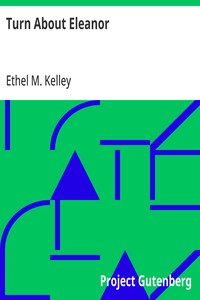
Turn About Eleanor — Background and Themes
(0 User reviews)
532
Project Gutenberg
2009
Not confirmed
Orphans -- Fiction; Guardian and ward -- Fiction
Readers of public-domain and historical texts
Project Gutenberg digital edition
en
Edition facts
Words
64,138
Reading time
279 min
Text sections
8
This digital edition of Turn About Eleanor — Background and Themes is described by source-level measurements including 64,138 words, 4 hr 39 min estimated reading time, and 8 detected text sections.
The text analysis averages about 16.9 words per sentence, while the detected sections provide another way to judge how the source is divided.
Project Gutenberg metadata also associates the work with “Orphans -- Fiction,” connecting these edition facts with the source record’s subject description.
Source:
Project Gutenberg record #28444
Ethel M. Kelley's 1917 novel follows orphaned Eleanor as she moves to New York to live with three aunts and three uncles, a setup that yields a comic, diary-driven narrative about unconventional family dynamics and a young girl's observations of adult entanglements.
Editorial Edition Score
4.7/5
★★★★★
★★★★★
Calculated from edition completeness, EPUB availability, text structure and catalogue metadata. Not a user rating.
How this score is calculated
- Description quality20 pts
- Title & short description10 pts
- Source metadata20 pts
- Text length15 pts
- Chapters / structure15 pts
- EPUB file integrity20 pts
Total of 100 points, scaled to a 2.5-5.0 range. Editions with an empty description or a missing EPUB file are not scored.
Edition quality
Read the Text
ey had been making their way through the Park; the searer, yellower Park of late November. It looked duller and more cheerless than David ever remembered it. The leaves rattled on the trees, and the sun went down suddenly.
"This is Central Park," he said. "In the spring it's very beautiful here, and all the people you know go motoring or driving in the afternoon."
He bowed to his mother's milliner in a little French runabout. The Frenchman stared frankly at the baby blue tam-o'-shanter and the tangled golden head it surmounted.
"Joseph could make you a peachy tam-o'-shanter looking thing of blue velvet; I'll bet I could draw him a picture to copy. Your Uncle David, you know, is an artist of a sort."
For the first time since their incongruous association began the child met his smile; her face relaxed ever so little, and the lips quivered, but she smiled a shy, little dawning smile. There was trust in it and confidence. David put out his hand to pat hers, but thought better of it.
"Eleanor," he said, "my mother knows our only living Ex-president, and the Countess of Warwick, one Vanderbilt, two Astors, and she's met Sir Gilbert Parker, and Rudyard Kipling. She also knows many of the stars and satellites of upper Fifth Avenue. She has, as well, family connections of so much weight and stolidity that their very approach, singly or in conjunction, shakes the earth underneath them.--I wish we could meet them all, Eleanor, every blessed one of them."
THE COOPERATIVE PARENTS
"I wonder how a place like this apartment will look to her," Beulah said thoughtfully. "I wonder if it will seem elegant, or cramped to death. I wonder if she will take to it kindly, or with an ill concealed contempt for its limitations."
"The poor little thing will probably be so frightened and homesick by the time David gets her here, that she won't know what kind of a place she's arrived at," Gertrude suggested. "Oh, I wouldn't be in your shoes for the next few days for anything in the world, Beulah Page; would you, Margaret?"
The third girl in the group smiled.
"I don't know," she said thoughtfully. "It would be rather fun to begin it."
"I'd rather have her for the first two months, and get it over with," Beulah said decisively. "It'll be hanging over your head long after my ordeal is over, and by the time I have to have her again she'll be absolutely in training. You don't come until the fifth on the list you know, Gertrude. Jimmie has her after me, then Margaret, then Peter, and you, and David, if he has got up the courage to tell his mother by that time."
"But if he hasn't," Gertrude suggested.
"He can work it out for himself. He's got to take the child two months like the rest of us. He's agreed to."
"He will," Margaret said, "I've never known him to go back on his word yet."
"Trust Margaret to stick up for David. Anyway, I've taken the precaution to put it in writing, as you know, and the document is filed."
"We're not adopting this infant legally."
"No, Gertrude, we can't,--yet, but morally we are. She isn't an infant, she's ten years old. I wish you girls would take the matter a little more seriously. We've bound ourselves to be responsible for this child's whole future. We have undertaken her moral, social and religious education. Her body and soul are to be--"
"Equally divided among us," Gertrude cut in.
Beulah scorned the interruption.
"--held sacredly in trust by the six of us, severally and collectively."
"Why haven't we adopted her legally then?" Margaret asked.
"Well, you see, there are practical objections. You have to be a corporation or an institution or something, to adopt a child as a group. A child can't have three sets of parents in the eyes of the law, especially when none of them is married, or have the least intention of being married, to each other.--I don't see what you want to keep laughing at, Gertrude. It's all a little unusual and modern and that sort of thing, but I don't think it's funny. Do you, Margaret?"
"I think that it's funny, but I think that it's serious, too, Beulah."
"I don't see what's funny about--" Beulah began hotly.
The novel opens with Eleanor, a child in a faded tam-o'-shanter and a shoddy new coat, riding up Fifth Avenue in a hansom cab beside her uncle David Bolling. David is making strained conversation, pointing out a flower shop and mentioning Eleanor's aunts—Beulah, Margaret, and Gertrude—whom she has not yet met. The scene establishes a tone of awkward formality: David is a conservative young man, raised to avoid the conspicuous, and Eleanor is a 'sporting child' willing to play along with a game she does not understand. The catalog subjects list 'Orphans -- Fiction' and 'Guardian and ward -- Fiction,' but the excerpts show a more complex arrangement: Eleanor is not simply a ward of a single guardian but is entering a household of multiple aunts and uncles, a 'cooperative' parenting scheme that the title's 'Turn About' may reference.
A Household of Six Parents
The catalog subjects reduce Eleanor's situation to 'Guardian and ward,' but the excerpts reveal a deliberately unusual family structure. Eleanor is taken in by three aunts—Beulah, Margaret, and Gertrude—and three uncles, including David and Jimmie. The chapter title 'The Cooperative Parents' suggests a planned, experimental arrangement. David Bolling, the young man from the opening, is described as 'naturally a conservative young man' who has been 'somewhat deflected' by his associations, hinting at tension between conventional expectations and the household's unconventionality. Later, a diary entry mentions a 'vow of celibacy' among the uncles, which David defends during a fight with his mother, Madam Bolling, who wants him to marry a rich girl. The diary also records that Eleanor 'reformed' Uncle Jimmie by making him sign a pledge—though she does not read it—and that Jimmie complains of being 'addicted to something worse than anything I could think of.' These details suggest that the uncles' bachelorhood is a deliberate, possibly comic, plot point, and that the 'guardian' role is distributed among six adults, each with their own quirks.
Eleanor's Voice Through Diary and Dialogue
The excerpts include a first-person diary entry that gives Eleanor a distinct voice, contrasting with the third-person narration of the opening. In the diary, she writes in a colloquial, observant style: 'I can’t write about that in this diary. I loved my grandmother and my grandmother loved me.' She describes her best friend Maggie Lou, who 'lies some, but she says it is because she had such an unhappy childhood.' The diary also recounts the fight between Uncle David and Madam Bolling, with Eleanor noting, 'I told Madam Bolling that I would help her to get Uncle David back, and I did.' This shows Eleanor as an active participant, not a passive ward. The diary entries are interspersed with the third-person narrative, creating a layered perspective. The opening chapter's third-person narration is more formal, focusing on David's internal thoughts—'He was naturally a conservative young man'—while the diary is immediate and personal. This shift in voice may be a structural device to show Eleanor's growth or to contrast adult and child viewpoints.
Setting and Social Milieu: Fifth Avenue to Harmon
The story moves between specific, named locations: Fifth Avenue, Cape Cod, Harmon (likely a school), and the Bolling family's home on the Hudson. The opening scene on Fifth Avenue in a hansom cab establishes a 1910s New York setting, with details like 'the flower shop' and 'window boxes.' The diary mentions a vacation 'up the Hudson to the Bollings’ again,' and a fight that ends those visits. The school setting at Harmon is evoked through dormitory life: 'Some of the girls are rather selfish about the eats, and come in and help themselves boldly when you are out of the room.' Maggie Lou posts signs like 'Closed for Repairs' over the candy box. These details ground the story in a specific social world—upper-middle-class New York and boarding school—but the excerpts do not reveal the full plot. The catalog subjects do not mention school or social comedy, yet the excerpts suggest that much of the novel's humor and conflict arises from Eleanor's navigation of these environments.
Readers should attend to the interplay between the third-person narrative and Eleanor's diary entries, as the diary provides a more candid, sometimes unreliable perspective on events. The 'cooperative parents' setup is central but its rules and origins are only hinted at in the excerpts; the full novel likely explores how this arrangement works in practice. The catalog subjects of orphan and guardian are accurate but reductive—the story appears to be as much about the adults' eccentricities as about Eleanor's adjustment.
That rainy afternoon, Eleanor’s sharp little asides about her six guardians felt less like comedy and more like a quiet map of how we learn to love imperfect people. Closing the book, my hand drifted to another shelf, and I found myself inside The Tale of Lal A Fantasy — Background and Themes, where the fantastical softened Eleanor’s realism into a gentler, stranger truth.
There are no reviews for this eBook.
There are no comments for this eBook.
Reader reflection
Take a moment to reflect on this book
Create a short personal record of your experience with this book.
Your progress
0
/
10
2
How did the book work for you overall?
3
Would you pass this book on to a friend?
4
How easy was the book to follow?
5
How useful did the reading feel?
6
What did you appreciate most?
7
How closely did the book connect with your experience?
8
Could you follow the author’s main argument?
9
What did this book teach you most?
10