1

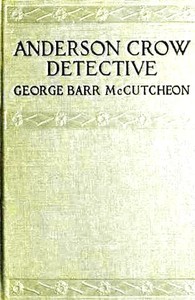
Anderson Crow, Detective — A Reader’s Guide
(0 User reviews)
602
Project Gutenberg
2009
Not confirmed
Fiction; Detective and mystery stories
Readers of public-domain and historical texts
Project Gutenberg digital edition
en
Edition facts
Words
79,142
Reading time
345 min
Text sections
9
The catalog record for Anderson Crow, Detective — A Reader’s Guide provides practical reading context through 79,142 words, 5 hr 45 min estimated reading time, and 9 detected text sections.
The text analysis averages about 13.6 words per sentence, while the detected sections provide another way to judge how the source is divided.
Project Gutenberg metadata also associates the work with “Fiction,” connecting these edition facts with the source record’s subject description.
Source:
Project Gutenberg record #28229
This editorial note examines how the opening, middle, and later excerpts of George Barr McCutcheon's 'Anderson Crow, Detective' guide a first reading, focusing on the small-town setting, the veiled lady mystery, and the protagonist's comic self-importance.
Editorial Edition Score
4.7/5
★★★★★
★★★★★
Calculated from edition completeness, EPUB availability, text structure and catalogue metadata. Not a user rating.
How this score is calculated
- Description quality20 pts
- Title & short description10 pts
- Source metadata20 pts
- Text length15 pts
- Chapters / structure15 pts
- EPUB file integrity20 pts
Total of 100 points, scaled to a 2.5-5.0 range. Editions with an empty description or a missing EPUB file are not scored.
Edition quality
Read the Text
Anderson looked at him in amazement. "Why, ain't you got any eyes? Hain't they saved the engine and every foot of hose the town owns?"
"They could have saved that much by staying at home in bed," said Mr. Squires dryly. "I've just seen Mr. Smock. He says there were fifty thousand bushels of wheat in the bins, waiting for cars to take it down to New York. Every bushel of it was going abroad for the Allies. Does that put any sort of an idea into your nut, Anderson?"
"Into your bean, I should say. Or, in other words, hair-pasture."
"He means head, Mr. Crow," explained Miss Sue Becker.
"Well, why don't he say head--that's what I'd like to know."
"Do you deduce anything from the fact that the grain was to go to the Allies, Anderson?" inquired Harry.
The harassed marshal scratched his head, but said: "Absolutely!"
"Well, what do you deduce, Mr. Hawkshaw?"
"I deduce, you derned jay, that old man Smock won't be able to deliver it. Move back, will you? You're right in my way, an'--"
"I suppose you know that the Germans are still fighting the Allies, don't you? Fighting 'em here as well as over in France? Now does _that_ help you any?"
Mr. Crow's jaw fell--but only for a second. He tightened it up almost immediately and with commendable dignity.
"My sakes alive, Harry Squires, you don't suppose I'm tellin' my real suspicions to any newspaper reporter, do you? How do I know you ain't a spy? Still, dog-gone you, if it will set your mind at rest, I'll say this much: I have positive proof that Smock's warehouse was set on fire by agents of the German gover'ment. That's one of the reasons I was a little late in gettin' to the fire. Now, don't try to pump me any more, 'cause I can't tell you anything that would jeopardize the interests of justice. Hey! Where in thunder are you fellers goin' with that hose an' engine?"
The firemen were on a dead run.
"We're goin' a couple of hundred yards down the road, so's we won't be killed when that front wall caves in," shouted Ed Higgins, without pausing. "Better come along, Anderson. She's beginning to bulge something awful."
Anderson Crow arose to the occasion.
"Lively now!" he barked through the trumpet. "Get that hose and engine back to a safe place! Can't you see the wall's about ready to fall? Everybody fall back! Women and children first! Women first, remember!"
Down the road fled the crowd, looking over its collective shoulders, so to speak--followed by the venerable fire apparatus and the still more venerable commander-in-chief.
Harry Squires, in his two-column account of the fire in the _Banner_, dilated upon the fact that the women failed to retain the advantage so gallantly extended by the men. For the matter of about ten or fifteen yards they _were_ first; after which, being handicapped by petticoats, they fell ingloriously behind. Some of the older ones--maliciously, he feared--impeded the progress of their protectors by neglecting to get out of the way in time, with the result that at least two men were severely bruised by falling over them--the case of Uncle Dad Simms being a particularly sad one. He collided head-on with the portly Mrs. Loop, and failing to budge her, suffered the temporary loss of a full set of teeth and nearly twenty minutes of consciousness. Mr. Squires went on to say that the only thing that saved Mr. Simms from being run over and killed by the fire-engine was the fact that the latter was about a block and a half ahead of him when the accident occurred.
Sparks soared high and far on the smoke-laden wind, scurrying townward across the barren quarry-lands. The vast canopy was red with the glow of flying embers and fire-lit clouds. Below, in the dusty road, swarmed the long procession of citizens. Grim, stark hemlocks gleamed in the weird, uncanny light that turned the green of their foliage and the black of their trunks into the colour of the rose on the side facing the fire, but left them dark and forbidding on the other. The telegraph-poles beyond the burning warehouse lining the railroad spur that ventured down from the main line some miles away and terminated at Smock's, loomed up like lofty gibbets in the ghastly light. Three quarters of a mile from the scene of the conflagration lay the homes of the people who lived on the rim of Tinkletown, and there also were the two churches and the motion-picture houses.
"We got to save them picture-houses," panted Anderson, and then in hasty apology,--"and the churches, too."
The first chapter, 'A Night to Be Remembered,' introduces Tinkletown on May 6, 1918, with two events that rouse the entire population. The narrative voice is genial and expansive, promising a history of the town by the estimable Miss Sue Becker. This framing establishes a community where everyone knows everyone, and the mundane—like apple prices—mingles with the mysterious. The excerpts immediately present Anderson Crow as a marshal who wears his detective badge on his suspenders, a detail that signals his blend of official pride and small-town informality.
The Veiled Lady as a Catalyst
The middle excerpt revolves around the Veiled Lady of Nixon Cottage, a woman who never removes her veil. The dialogue among the men on the porch reveals how the town processes novelty: through gossip, speculation, and comic misinterpretation. Harry Squires pushes for investigation, while Anderson Crow deflects with literal-minded remarks about beds and mustard plasters. The keyhole anecdote—Angie Nixon overhearing a remark about sleeping in 'a thing like this'—is the closest the excerpts come to evidence. The mystery is less about the woman than about how Tinkletown’s inhabitants construct stories from fragments.
Anderson Crow’s Voice and Self-Regard
Crow’s speech is peppered with colloquialisms and defensive pride. He objects to being called 'Hawkshaw,' a reference to a famous fictional detective, and his badge is 'for obvious reasons' attached to his suspenders on a hot night. His reasoning is often comically concrete: he won’t criticize Mrs. Nixon’s beds because he hasn’t slept in one. Yet he also shows a flicker of method, inspecting an apple for 'a suitable place to begin' before speaking. The excerpts suggest a character who takes himself seriously but is consistently undercut by the author’s gentle satire.
Small-Town Social Dynamics
The porch conversation includes Alf Reesling, Newt Spratt, and Mr. Jones, each contributing personal tangents—a tooth extraction, a daughter’s graduation dress. These digressions are not filler; they establish a community where personal history is public property. The men’s concern about veils spreading among local women hints at anxiety over identity and recognition. The line 'I recognized her feet' (referring to Sue Becker) shows how familiarity operates in a small town: faces may be hidden, but feet are known. The excerpts capture a social fabric where every detail is noted and interpreted.
Pacing and the Promise of Plot
The excerpts move from a broad community event to a focused mystery, then to a long legal appendix. The opening’s promise of two important events creates expectation, but the middle excerpt delays resolution, dwelling on talk. This pacing suggests the book values atmosphere and character over rapid detection. The later excerpts shift to trial scenes and a confession, but the fragments provided do not reveal how the veiled lady plot resolves. A first reader should expect a leisurely narrative where the detective’s bluster and the town’s gossip are as central as the crime.
These excerpts position the reader as a fellow townsperson, privy to the same incomplete information as the characters. The mystery is less about solving a crime than about watching a community react to the unknown. Pay attention to the gaps: what the characters choose to ignore, what they embellish, and how Crow’s authority is both asserted and undermined. The book rewards patience with its comic texture rather than puzzle-box plotting.
Re-reading the guide’s notes on Anderson Crow’s comic self-regard, I found myself smiling at how McCutcheon winked at his own small-town world. That same affectionate, knowing laughter surfaced later in my mind, tugging me toward a quieter shelf where The Wit and Humor of America, Volume IX (of X) — A Closer Reading waits—a gentler echo of that same warm, unhurried amusement, like an old friend’s nod.
There are no reviews for this eBook.
There are no comments for this eBook.
Reader reflection
Before you leave, reflect on the book
Use these questions to collect your thoughts before moving on.
Your progress
0
/
10
2
What was your overall reaction to the book?
3
Is this a title you would suggest to others?
4
How easy was the book to follow?
5
How personally connected did you feel to the book?
6
Did you gain anything practical from the text?
7
Could you see yourself revisiting this book?
8
Did the story or argument move comfortably?
9
What changed or sharpened your thinking?
10