1

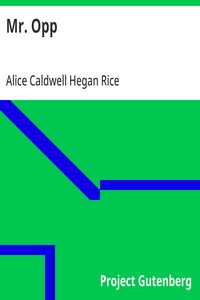
Mr. Opp — Reading Companion
(0 User reviews)
365
Project Gutenberg
2008
Not confirmed
Siblings -- Fiction; Kentucky -- Fiction; Newspaper editors -- Fiction
Readers of public-domain and historical texts
Project Gutenberg digital edition
en
Edition facts
Words
55,565
Reading time
242 min
Text sections
7
The source record for Mr. Opp — Reading Companion measures this digital text at 55,565 words, 4 hr 2 min estimated reading time, and 7 detected text sections.
The text analysis averages about 16.1 words per sentence, while the detected sections provide another way to judge how the source is divided.
Project Gutenberg metadata also associates the work with “Siblings -- Fiction,” connecting these edition facts with the source record’s subject description.
Source:
Project Gutenberg record #25070
This editorial note examines how the opening, middle, and later excerpts of Alice Hegan Rice's Mr. Opp guide a first reading, focusing on the introduction of D. Webster Opp, the arrival of Guinevere and Hinton, and the novel's narrative voice.
Editorial Edition Score
4.7/5
★★★★★
★★★★★
Calculated from edition completeness, EPUB availability, text structure and catalogue metadata. Not a user rating.
How this score is calculated
- Description quality20 pts
- Title & short description10 pts
- Source metadata20 pts
- Text length15 pts
- Chapters / structure15 pts
- EPUB file integrity20 pts
Total of 100 points, scaled to a 2.5-5.0 range. Editions with an empty description or a missing EPUB file are not scored.
Edition quality
Read the Text
Jimmy had been waiting since nine in the morning, and it was now well past noon. He was a placid gentleman of curvilinear type, short of limb and large of girth. His trousers, of that morose hue termed by the country people "plum," reached to his armpits, and his hat, large and felt and weather-beaten, was only prevented from eclipsing his head by the stubborn resistance of two small, knob-like ears.
"Mr. Opp ain't been back to the Cove for a long while, has he?" asked the ferryman, whose intellectual life depended solely upon the crumbs of information scattered by chance passers-by.
"Goin' on two years," said Mr. Fallows. "Reckon he's been so busy formin' trusts and buyin' out railways and promotin' things generally that he ain't had any time to come back home. It's his step-pa's funeral that's bringin' him now. The only time city folks seem to want to see their kin folks in the country is when they are dead."
"Ain't that him a-comin' down the bank?" asked the ferryman, shading his eyes with his hands.
Mr. Fallows, with some difficulty, got to his feet.
"Yes, that's him all right. Hustlin' to beat the band. Wonder if he takes me for a street car."
Coming with important stride down the wharf, and whistling as he came, was a small man of about thirty-five. In one hand he carried a large suit-case, and in the other a new and shining grip. On both were painted, in letters designed to be seen, "D. Webster Opp, Kentucky."
In fact, everything about him was evidently designed to be seen. His new suit of insistent plaid, his magnificent tie sagging with the weight of a colossal scarf-pin, his brown hat, his new tan shoes, all demanded individual and instant attention.
The only insignificant thing about Mr. Opp was himself. His slight, undeveloped body seemed to be in a chronic state of apology for failing properly to set off the glorious raiment wherewith it was clothed. His pock-marked face, wide at the temples, sloped to a small, pointed chin, which, in turn, sloped precipitously into a long, thin neck. It was Mr. Opp's eyes, however, that one saw first, for they were singularly vivid, with an expression that made strangers sometimes pause in the street to ask him if he had spoken to them. Small, pale, and red of rim, they nevertheless held the look of intense hunger--hunger for the hope or the happiness of the passing moment.
As he came bustling down to the water's-edge he held out a friendly hand to Jimmy Fallows.
"How are you, Jimmy?" he said in a voice freighted with importance. "Hope I haven't kept you waiting long. Several matters of business come up at the last and final moment, and I missed the morning train."
Jimmy, who was pouring gasolene into a tank in the launch, treated the ferryman to a prodigious wink.
"Oh, not more'n four or five hour," he said, casting side glances of mingled scorn and admiration at Mr. Opp's attire. "It is a good thing it was the funeral you was tryin' to get to instid of the death-bed."
"Oh, that reminds me," said Mr. Opp, suddenly exchanging his air of cheerfulness for one of becoming gravity--"what time is the funeral obsequies going to take place?"
"Whenever we git there," said Jimmy, pushing off the launch and waving his hand to the ferryman. "You're one of the chief mourners, and I'm the undertaker; there ain't much danger in us gettin' left."
Mr. Opp deposited his baggage carefully on the seat, and spread his coat across the new grip to keep it from getting splashed.
"How long was Mr. Moore sick?" he asked, fanning himself with his hat.
"Well," said Jimmy, "he was in a dangerous and critical condition for about twenty-one years, accordin' to his own account. I been seein' him durin' that time on a average of four times a day, and last night when I seen him in his coffin it was the first time the old gentleman failed to ask me to give him a drink on account of his poor health."
"Is Ben there?" asked Mr. Opp, studying a time-table, and making a note in his memorandum-book.
"Your brother Ben? Yes; he come this mornin' just before I left. He was cussin' considerable because you wasn't there, so's they could go on and git through. He wants to start back to Missouri to-night."
"Is he out at the house?"
"No; he's at Your Hotel."
Mr. Opp looked up in surprise, and Jimmy chuckled.
The novel opens with a ferryman and Jimmy Fallows discussing Mr. Opp before he appears, establishing him as a man with a "talent for missing things." When Mr. Opp finally arrives, his description emphasizes his "insistent plaid" suit and "colossal scarf-pin," yet his "slight, undeveloped body" seems apologetic. This contrast between his grandiose appearance and his small stature sets up a central tension: Opp's aspirations versus his reality.
Introducing D. Webster Opp
The first excerpt presents Mr. Opp through the eyes of others. Jimmy Fallows describes him as someone who misses opportunities, and the ferryman notes his long absence. When Opp appears, his name is painted on his luggage in letters "designed to be seen," and his clothing demands attention. Yet the narrator notes that "the only insignificant thing about Mr. Opp was himself." This juxtaposition of outward show and inward insignificance is a key motif. The reader is primed to see Opp as a figure of comic ambition, but also one who may be more complex.
A New Character Arrives
In the middle excerpt, Guinevere and Hinton approach the Cove by steamer. Hinton, a struggling writer with eye problems, is in a "state of black dejection." Guinevere, described as having a "thoughtful face" and being "wistful," recites lines from Swinburne: "That even the weariest river / Winds somewhere safe to sea." This literary allusion hints at themes of weariness and hope. When they see Mr. Opp on the dock, "madly waving his hat," Guinevere identifies him with indignation: "Why, of course; that's Mr. Opp." The scene shifts the focus from Opp's comic entrance to the perspectives of these new characters.
Hinton's Ambition and Opp's Role
Later, Hinton waits for Mr. Opp at "Your Hotel," run by Jimmy Fallows. Hinton's ambition to become an author is thwarted by his failing eyesight, and he faces the possibility of losing his job. The hotel bustles with activity, but Hinton remains outside. Jimmy Fallows reassures him that Mr. Opp will arrive soon, having "stopped by to take his girl home." This detail suggests Opp has personal ties and a life beyond his public persona. The excerpt deepens the reader's understanding of Opp as a local figure who is both comic and connected.
Narrative Voice and Structure
Rice employs a third-person narrator who often reveals characters through dialogue and action. The opening relies on the ferryman and Jimmy Fallows to set the scene, while later sections shift to Hinton's interior thoughts. The prose is economical, with vivid details like Jimmy's "plum" trousers and "knob-like ears." The structure moves from a communal introduction of Opp to individual character studies. The excerpts suggest that the novel balances humor with pathos, as Opp's grand gestures contrast with his small stature, and Hinton's literary aspirations clash with his physical limitations.
These excerpts guide a first reading by establishing Mr. Opp as a character defined by his contradictions: he is both absurd and earnest. The arrival of Guinevere and Hinton broadens the narrative, introducing themes of ambition and disappointment. Readers should attend to how Rice uses dialogue and description to build character, and how the setting of the Kentucky Cove shapes the story. The novel's tone, as seen in these passages, is gently ironic but not unkind.
Sometimes I catch myself thinking about how Mr. Opp lets you sit with its gentle absurdities without rushing the mood, and it reminds me of the quieter edges in Simon — Background and Themes. Both have that unhurried way of letting characters simply be, without needing to prove anything. It’s like revisiting a familiar porch and finding the same warm breeze still there.
There are no reviews for this eBook.
There are no comments for this eBook.
Reader reflection
What was your reading experience?
Capture what you thought, learned, and would like to remember.
Your progress
0
/
10
2
How much did you enjoy the reading experience?
3
How likely are you to recommend this book?
4
How demanding did the text feel?
5
Was the book easy to understand?
6
Did the story or argument move comfortably?
7
Was the book what you thought it would be?
8
Would you like to discuss this book with someone?
9
What did this book teach you most?
10