1

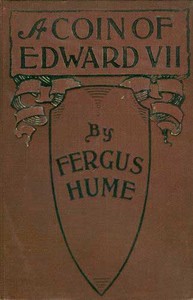
A Coin of Edward VII: A Detective Story — Themes and Context
(0 User reviews)
133
Project Gutenberg
2008
Not confirmed
Fiction; Detective and mystery stories
Readers of public-domain and historical texts
Project Gutenberg digital edition
en
Edition facts
Words
83,057
Reading time
362 min
Text sections
8
Before opening A Coin of Edward VII: A Detective Story — Themes and Context, the edition data offers a quick orientation: 83,057 words, 6 hr 2 min estimated reading time, and 8 detected text sections.
The text analysis averages about 12.0 words per sentence, while the detected sections provide another way to judge how the source is divided.
Project Gutenberg metadata also associates the work with “Fiction,” connecting these edition facts with the source record’s subject description.
Source:
Project Gutenberg record #26063
Fergus Hume's 1903 detective novel opens with a Christmas tree and an anonymous letter, introducing a murder mystery that unfolds through the perspectives of Giles Ware and the eccentric Karacsay family. The narrative balances a central crime with social comedy and a romance subplot, all set against a backdrop of snow and suspicion.
Editorial Edition Score
4.7/5
★★★★★
★★★★★
Calculated from edition completeness, EPUB availability, text structure and catalogue metadata. Not a user rating.
How this score is calculated
- Description quality20 pts
- Title & short description10 pts
- Source metadata20 pts
- Text length15 pts
- Chapters / structure15 pts
- EPUB file integrity20 pts
Total of 100 points, scaled to a 2.5-5.0 range. Editions with an empty description or a missing EPUB file are not scored.
Edition quality
Read the Text
Giles said as much to Miss Denham, and she nervously agreed with him as though fearful lest her assent should reach the ears of Mrs. Parry. "She has no love for me," whispered Anne. "I think you had better talk to Daisy, Mr. Ware."
"I prefer to talk to you," said Giles coolly. "Daisy is like her name--a sweet little English meadow flower--and I love her very dearly. But she has never been out of England, and sometimes we are at a loss what to talk about. Now you?"
"I am a gipsy," interrupted Anne, lest he should say something too complimentary; "a she-Ulysses, who has travelled far and wide. In spite of your preference for my conversation, I wish I were Daisy."
"Do you?" asked Ware eagerly. "Why?"
Anne flushed and threw back her head proudly. She could not altogether misunderstand his meaning or the expression of his eyes, but she strove to turn the conversation with a laugh. "You ask too many questions, Mr. Ware," she said coldly. "I think Daisy is one of the sweetest of girls, and I envy her. To have a happy home, a kind guardian as Mr. Morley is, and a----" She was about to mention Giles, but prudently suppressed the remark.
"Go on," he said quietly, folding his arms.
She shook her head and bit her lip. "You keep me from my work. I must attend to my duties. A poor governess, you know." With a laugh she joined the band of children, who were besieging Morley.
Giles remained where he was, his eyes fixed moodily on the ground. For more than five months he had fought against an ever-growing passion for the governess. He knew that he was in honor bound to marry Daisy, and that she loved him dearly, yet his heart was with Anne Denham. Her beauty, her brilliant conversation, her charm of manner, all appealed to him strongly. And he had a shrewd suspicion that she was not altogether indifferent to him, although she loyally strove to hide her true feelings. Whenever he became tender, she ruthlessly laughed at him: she talked constantly of Daisy and of her many charms, and on every occasion strove to throw her into the company of Giles. She managed to do so on this occasion, for Giles heard a rather pettish voice at his elbow, and looked down to behold a flushed face. Daisy was angry, and looked the prettier for her anger.
"You have scarcely spoken to me all night," she said, taking his arm; "I do think you are unkind."
"My dear, you have been so busy with the children. And, indeed," he added, with a grave smile, "you are scarcely more than a child yourself, Daisy."
"I am woman enough to feel neglect."
"I apologize--on my knees, dearest."
"Oh, it's easy saying so," pouted Daisy, "but you know Anne----"
"What about Miss Denham?" asked Giles, outwardly calm.
"She is a very charming woman, but you are to be my wife. Jealous little girl, can I not be ordinarily civil to Miss Denham without you getting angry?"
"You need not be so _very_ civil."
"I won't speak to her at all if you like," replied Ware, with a fine assumption of carelessness.
"Oh, if you only wouldn't," Daisy stopped--then continued passionately, "I wish she would go away. I don't like her."
"She is fond of you, Daisy."
"Yes. And a cat is fond of a mouse. Mrs. Parry says----"
"Don't quote that odious woman, child," interrupted Ware sharply. "She has a bad word for everyone."
"Well, she doesn't like Anne."
"Does she like anyone?" asked Giles coolly. "Come, Daisy, don't wrinkle your face, and I'll take you out for a drive in my motor-car in a few days."
"To-morrow! to-morrow!" cried Daisy, her face wreathed in smiles.
"No. I daren't do that on Christmas Day. What would the rector say? As the lord of the manor I must set an example. On Boxing Day if you like."
"Certainly. Who do you expect me to ask other than you?"
"Anne," said Daisy spitefully, and before he could reply she also moved away to join the children. Giles winced. He felt that he was in the wrong and had given his little sweetheart some occasion for jealousy. He resolved to mend his ways and shun the too fascinating society of the enchantress. Shaking off his moody feeling, he came forward to assist Morley. The host was a little man, and could not reach the gifts that hung on the topmost boughs of the tree. Giles being tall and having a long reach of arm, came to his aid.
"That's right, that's right," gasped Morley, his round face red and shining with his exertions, "the best gifts are up here."
The novel begins not with a corpse but with a Christmas tree—a festive gathering that quickly darkens when an anonymous letter arrives, warning of danger. Fergus Hume establishes a tone of domestic suspense, where holiday cheer coexists with whispered threats. The early chapters introduce Giles Ware, a young man drawn into the orbit of the Karacsay family, whose foreign manners and mysterious past hint at deeper secrets. The narrative voice is brisk, with a fondness for theatrical dialogue and comic relief, as seen in the landlord Morris's mock-French flourishes. This blend of light comedy and looming menace sets the stage for a detective story that prioritizes atmosphere and character over procedural detail.
A Crime in the Snow
The murder occurs offstage, discovered after the fact: a woman's body lies face-down on the snow, as the illustrated frontispiece reveals. Hume withholds the identity of both victim and perpetrator, instead focusing on the aftermath. The investigation proceeds through a series of interviews and chance encounters, with clues emerging from overheard conversations and misplaced objects. The snow itself becomes a recurring motif—blanketing the landscape, muffling footsteps, and preserving evidence. Readers should note how the setting of a small English village in winter amplifies the sense of isolation and hidden knowledge. The detective figure, if one exists, is not immediately apparent; suspicion shifts among the characters, including the enigmatic Princess Karacsay and her daughter Olga.
Foreign Intrigue and Family Ties
The Karacsay family brings a continental flavor to the English countryside. Princess Karacsay, described as a "Cleopatra of the West," speaks with a "rough burr" and complains about the cold and the coffee. Her daughter Olga, a singer, defies her father's wishes and insists on her independence. Their presence introduces themes of exile, class, and cultural clash. Hume uses their foreignness to create ambiguity: are they victims, suspects, or mere bystanders? The princess's barbaric jewels and languid air contrast sharply with the practical concerns of the local police. Readers should pay attention to the dynamics within the family—the tension between Olga and her father, the princess's protective attitude—as these may hold keys to the mystery.
Comic Relief and Verbal Play
Hume leavens the suspense with humor, particularly through the character of Morris, the landlord, who peppers his speech with malapropisms and mock-French phrases like "garkong" and "femmie de chambers." His daughter Henrietta, who taught him "the languidge," adds another layer of gentle satire. These comic interludes serve to humanize the setting and provide breathing room between revelations. The dialogue is often theatrical, with characters striking poses and delivering lines that feel stage-directed. This style may strike modern readers as artificial, but it reflects the novel's roots in Victorian melodrama. The humor also underscores the class distinctions: Morris's pretensions are both endearing and absurd, highlighting the gap between his aspirations and his station.
The Unreliable First Impression
The excerpts offer only fragments of the plot, but they reveal a pattern: first impressions are repeatedly misleading. Giles Ware is charmed by the princess, yet her languor may conceal calculation. Olga seems forthright, but her defiance of her father suggests hidden motives. The anonymous letter itself is a warning that may be genuine or a ruse. Hume encourages readers to question every character's surface presentation. The narrative voice, while omniscient, withholds key information, doling out clues through dialogue and description rather than direct exposition. As you read, track each character's stated desires against their actions, and note how the setting—a closed community in winter—limits alibis and amplifies suspicion.
Approach A Coin of Edward VII as a puzzle box wrapped in social comedy. The title object, a coin bearing the king's image, may be a clue or a red herring; the excerpts do not reveal its significance. Hume's strength lies in his ability to juggle multiple tones—suspense, romance, farce—without losing narrative momentum. Let the characters' contradictions guide your reading, and remember that in a Fergus Hume novel, the obvious answer is rarely the correct one.
Reading A Coin of Edward VII, I kept returning to that odd feeling of snowbound houses holding secrets, how the Karacsay family’s eccentricity felt less like color than a kind of camouflage. It reminded me of another quiet stroll through village clutter and misplaced suspicions, the gentle absurdity of Anderson Crow’s world. There’s a shared softness there, a patience for human folly, that lingers. Anderson Crow, Detective — A Reader’s Guide captures that same unhurried charm, as if both stories breathe the same crisp winter air.
There are no reviews for this eBook.
There are no comments for this eBook.
Reader reflection
How did this book work for you?
Your answers remain private and are stored only in this browser.
Your progress
0
/
10
2
How much did you enjoy the reading experience?
3
Would you recommend this book to another reader?
4
How easy was the book to follow?
5
What was its emotional impact?
6
Would you start a conversation about this book?
7
Do you expect to return to this book?
8
Was the book what you thought it would be?
9
What changed or sharpened your thinking?
10