1

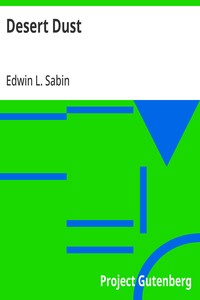
Desert Dust — Key Ideas to Explore
(0 User reviews)
2330
Project Gutenberg
2008
Not confirmed
Fiction; Western stories
Readers of public-domain and historical texts
Project Gutenberg digital edition
en
Edition facts
Words
73,220
Reading time
319 min
Text sections
9
The catalog record for Desert Dust — Key Ideas to Explore provides practical reading context through 73,220 words, 5 hr 19 min estimated reading time, and 9 detected text sections.
The text analysis averages about 12.0 words per sentence, while the detected sections provide another way to judge how the source is divided.
Project Gutenberg metadata also associates the work with “Fiction,” connecting these edition facts with the source record’s subject description.
Source:
Project Gutenberg record #27437
An 1868 transcontinental railroad journey becomes a Western adventure as a young Easterner, advised to go West for his health, encounters Mormons, teamsters, and desert life in Edwin L. Sabin's first-person narrative, illustrated by J. Clinton Shepherd.
Editorial Edition Score
4.7/5
★★★★★
★★★★★
Calculated from edition completeness, EPUB availability, text structure and catalogue metadata. Not a user rating.
How this score is calculated
- Description quality20 pts
- Title & short description10 pts
- Source metadata20 pts
- Text length15 pts
- Chapters / structure15 pts
- EPUB file integrity20 pts
Total of 100 points, scaled to a 2.5-5.0 range. Editions with an empty description or a missing EPUB file are not scored.
Edition quality
Read the Text
There was a quizzical uplift in her frank, arch smile.
"I am, sir. To Benton City, of Wyoming Territory."
"You are acquainted there?" I ventured.
"Yes, sir. I am acquainted there. And you are from Benton?"
"Oh, no," I assured. "I am from New York State." As if anybody might not have known. "But I have just purchased my ticket to Benton, and----" I stammered, "I have made bold to wonder if you would not have the goodness to tell me something of the place--as to accommodations, and all that. You don't by any chance happen to live there, do you?"
"And why not, sir, may I ask?" she challenged.
I floundered before her query direct, and her bewildering eyes and lips--all tantalizing.
"I didn't know--I had no idea--Wyoming Territory has been mentioned in the newspapers as largely Indian country----"
"At Benton we are only six days behind New York fashions," she smiled. "You have not been out over the railroad, then, I suspect. Not to North Platte? Nor to Cheyenne?"
"I have never been west of Cincinnati before."
"You have surely been reading of the railroad? The Pacific Railway between the East and California?"
"Yes, indeed. In fact, a friend of mine, named Stephen Clark, nephew of the Honorable Thurlow Weed formerly of Albany, was killed a year ago by your Indians while surveying west of the Black Hills. And of course there have been accounts in the New York papers."
"You are not on survey service? Or possibly, yes?"
"A pleasure trip to end of track?"
She evidently was curious, but I was getting accustomed to questions into private matters. That was the universal license, out here.
"The pleasure of finding health," I laughed. "I have been advised to seek a location high and dry."
"Oh!" She dimpled adorably. "I congratulate you on your choice. You will make no mistake, then, in trying Benton. I can promise you that it is high and reasonably dry. And as for accommodations--so far as I have ever heard anybody is accommodated there with whatever he may wish." She darted a glance at me; stepped aside as if to leave.
"I am to understand that it is a city?" I pleaded.
"Benton? Why, certainly. All the world is flowing to Benton. We gained three thousand people in two weeks--much to the sorrow of poor old Cheyenne and Laramie. No doubt there are five thousand people there now, and all busy. Yes, a young man will find his opportunities in Benton. I think your choice will please you. Money is plentiful, and so are the chances to spend it." She bestowed upon me another sparkling glance. "And since we are both going to Benton I will say 'Au revoir,' sir." She left me quivering.
"You do live there?" I besought, after; and received a nod of the golden head as she entered the sacred Ladies' Waiting Room.
Until the train should be made up I might only stroll, restless and strangely buoyed, with that vision of an entrancing fellow traveler filling my eyes. Summoned in due time by the clamor "Passengers for the Pacific Railway! All aboard, going west on the Union Pacific!" here amidst the platform hurly-burly of men, women, children and bundles I had the satisfaction to sight the black-clad figure of My Lady of the Blue Eyes; hastening, like the rest, but not unattended--for a brakeman bore her valise and the conductor her parasol. The scurrying crowd gallantly parted before her. It as promptly closed upon her wake; try as I might I was utterly unable to keep in her course.
Obviously, the train was to be well occupied. Carried on willy-nilly I mounted the first steps at hand; elbowed on down the aisle until I managed to squirm aside into a vacant seat. The remaining half was at once effectually filled by a large, stout, red-faced woman who formed the base of a pyramid of boxes and parcels.
My neighbor, who blocked all egress, was going to North Platte, three hundred miles westward, I speedily found out. And she almost as speedily learned that I was going to Benton.
She stared, round-eyed.
"I reckon you're a gambler, young man," she accused.
"No, madam. Do I look like a gambler?"
"You can't tell by looks, young man," she asserted, still suspicious, "Maybe you're on spec', then, in some other way."
"I am seeking health in the West, is all, where the climate is high and dry."
"My Gawd!" she blurted. "High and dry! You're goin' to the right place. For all I hear tell, Benton is high enough and dry enough. Are your eye-teeth peeled, young man?"
"My eye-teeth?" I repeated. "I hope so, madam. Are eye-teeth necessary in Benton?"
The narrator of Desert Dust introduces himself as a twenty-five-year-old from Albany, New York, who has been advised by physicians to “go West” for his health. He chooses the most extreme option: traveling via the Union Pacific Railroad in the summer of 1868, when the rails were still being laid across the continent. The opening chapter immediately establishes a first-person voice that is self-aware, slightly ironic, and attentive to social detail—he notes the brakeman's “sky-blue army pantaloons” and “flaring-brimmed black slouch hat” before admitting that his own attention is fixed on “a pair of exquisite blue eyes” belonging to a fellow passenger.
The catalog classifies this as a Western story, but the early chapters are as much a travelogue of the transcontinental journey as a frontier tale. The narrator's observations of prairie dogs, antelope, and the “miraculous Pacific Railway” ground the narrative in a specific historical moment, while his encounters with Mormons and teamsters introduce the cultural tensions of the region.
A First-Person Narrator with an Eastern Perspective
The narrator's voice is distinctive: educated, self-deprecating, and prone to dry humor. He describes his own motives with a mix of desperation and bravado—he has “taken the bull by the horns” in going West, but he also admits that he could have found “handsome women a-plenty in the East.” This self-awareness sets him apart from the typical Western hero. His observations are filtered through an Eastern sensibility: he notes the brakeman's odd uniform, the “curious rodents styled prairie dogs,” and the “flat country of far horizons” with a traveler's wonder. The first-person narration allows Sabin to contrast the narrator's bookish background with the rough realities of the trail, a tension that drives much of the early conflict.
Mormon-Gentile Tensions on the Trail
A significant portion of the excerpted text revolves around the narrator's interactions with Mormon characters, particularly a young teamster who boasts of being “the dangest best shot with a Colt's in this hyar train” and challenges the narrator to a shooting match for “two bits.” The dialogue is laced with religious animosity: the teamster calls the narrator a “Gentile” and insists that “the Saints settled that country an’ it’s ourn.” The narrator responds with measured sarcasm, asking “How much of the world have you seen?” when the teamster claims all the rest of the world has “sold itself to the devil.” These exchanges reveal the sectarian divisions of the 1860s frontier, where Mormon settlers and non-Mormon travelers coexisted uneasily. The catalog subject “Western stories” does not fully capture this specific cultural friction, which is central to the narrator's experience.
The Physical Demands of Wagon Travel
The narrator's role as a “mule-whacker” (or “mule-skinner”) is described with a mix of pride and self-mockery. He trudges “manfully at the left fore wheel” behind four span of mules, trailing an eighteen-foot lash and “occasionally well-nigh cutting off my own ear when I tried to throw it.” The train is a mixed one—Gentile mules and Mormon oxen—and the pace is set by the slower oxen, making it a “bull train” in vernacular. Sabin includes specific details of camp life: the bustle of lashing loads, tautening covers, and the commands “Stretch out, stretch out!” as the wagons form line. The narrator notes that the sun was “more vexatious” as they entered Benton's “boiling main street,” and the dust is described as “hot, scalding.” These concrete observations ground the story in the physical reality of overland travel, far from the romanticized West of popular fiction.
Readers should note that the excerpts provided cover only the first several chapters of a 22-chapter novel. The narrator's journey is clearly just beginning, and the title Desert Dust hints at the arid landscapes to come. The illustrations by J. Clinton Shepherd, including a frontispiece captioned “Like some land of Heart’s Desire,” suggest a visual complement to the text's descriptive passages. The narrative voice—educated, observant, and occasionally wry—promises a Western story filtered through a distinctly Eastern lens, one that may continue to explore the gap between expectation and reality on the frontier.
That rainy afternoon, Desert Dust kept me company—Sabin’s young traveler, rattling through Utah, learning how slowly trust builds in dry country. I closed it feeling the weight of quiet reckonings, how a landscape can change a person without announcement. Later, almost by accident, I reached for The Reckoning — A Closer Reading, and found the same patient gravity, waiting between lines.
There are no reviews for this eBook.
There are no comments for this eBook.
Reader reflection
Record your reading impressions
A brief reflection can help important ideas stay with you longer.
Your progress
0
/
10
2
What was your overall reaction to the book?
3
How likely are you to recommend this book?
4
How easy was the book to follow?
5
What did you appreciate most?
6
Did the book deliver what you hoped for?
7
Did any part of the book feel personally relevant?
8
How distinctive were its ideas or approach?
9
In one sentence, what did you learn?
10