1

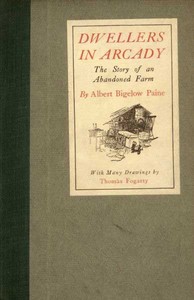
Dwellers in Arcady: The Story of an Abandoned Farm — Themes and Context
(0 User reviews)
1279
Project Gutenberg
2009
Not confirmed
Farm life -- Fiction; Abandoned farms -- Fiction
Readers of public-domain and historical texts
Project Gutenberg digital edition
en
Edition facts
Words
46,984
Reading time
205 min
Text sections
6
Before opening Dwellers in Arcady: The Story of an Abandoned Farm — Themes and Context, the edition data offers a quick orientation: 46,984 words, 3 hr 25 min estimated reading time, and 6 detected text sections.
The text analysis averages about 21.0 words per sentence, while the detected sections provide another way to judge how the source is divided.
Project Gutenberg metadata also associates the work with “Farm life -- Fiction,” connecting these edition facts with the source record’s subject description.
Source:
Project Gutenberg record #28027
An editorial note on Albert Bigelow Paine's 'Dwellers in Arcady,' focusing on its narrative voice, shifts in pace, and sensory language as revealed in excerpts about an abandoned farm in Connecticut.
Editorial Edition Score
4.7/5
★★★★★
★★★★★
Calculated from edition completeness, EPUB availability, text structure and catalogue metadata. Not a user rating.
How this score is calculated
- Description quality20 pts
- Title & short description10 pts
- Source metadata20 pts
- Text length15 pts
- Chapters / structure15 pts
- EPUB file integrity20 pts
Total of 100 points, scaled to a 2.5-5.0 range. Editions with an empty description or a missing EPUB file are not scored.
Edition quality
Read the Text
Westbury was soon to become we should have given him a closer inspection. However, he did not devote himself to us. He appeared to be on terms of old acquaintance with our driver, climbed into the front seat beside him, and lost himself in news from the outlying districts. The telephone had not then reached the countryside, and our driver brought the latest bulletins. The death of a horse in Little Boston, the burning of a barn in Sanfordtown, the elopement of an otherwise estimable lady with a peddler, marked the beginning of our intimacy with the affairs of Brook Ridge.
The hill was steep, and in the open field at one side a little cascade leaped and glistened as it went racing to the river below.
"That's the brook that runs through your farm," Mr. Westbury said, quite casually, in the midst of his interchanges with the driver.
"Our farm!" I felt a distinct thrill. And a brook on it! All my life I had dreamed of owning a brook.
"Any trout in it?" I ventured, trying to be calm.
"Best trout-brook in the township. Ain't it, Ed?"--to the driver.
"Has that name," Ed assented, nodding. "I never fish, myself, but I've seen some good ones they said come out of it."
We were up the hill by this time, and Mr. Westbury waved his hand to a sloping meadow at the left.
"That's one of the fields. Over there on the right is some of your timber, and up the hill yonder is the rest of it. Thirty-one acres, more or less. The brook runs through all of it--crosses the road yonder where you see that bridge."
I could feel my pulse getting quicker. There was no widely extended view, but there was a snug coziness about these neighborly meadows and wooded slopes, with the brook winding between; this friendly road with its ancient stone walls, all but concealed now by a mass of ferns or brake on one side, and on the other by a tangle of tall grass, goldenrod, purple-plumed Joe Pye weed, wild grape with big mellowing clusters, wild clematis in full bloom. New England in summer-time! What other land is like it? Our brook, our farm, here in the land of our fathers! There were a warmth, a glow, a poetry in the thought that cannot be put down in words--something to us new and wonderful, yet as old as human wandering and return.
But then all at once we were pulling up abreast of two massive maple-trees and some stone steps.
"And here is your house," said William C. Westbury.
_Ghosts like good architecture_
I believe I cannot quite give to-day my first impression of the house. In the years that have followed it has blended into so many other impressions that I could never be sure I was getting the right one. I had better confine myself to its physical appearance and what was perhaps a reflex impression--say, number two.
One glance was enough to show that it was all that the other old house was not. It did not sag, or lurch, or do any of those disreputable things. It stood up as straight and was as firm on its foundations as on the day when its last hand-wrought nail had been driven home, a century or so before. No mistaking its period or architecture--it was the long-roofed salt-box type, the first Connecticut habitation that followed the pioneer cabin; its vast central chimney had held it unshaken during the long generations of sun and storm.
Not that it was intact--oh, by no means. Its wide weather-boards were broken and falling; the red paint they had once known had become a mere memory, its shingles were moss-grown and curling, the grass was uncut. The weeds about the entrances and rotting well-curb grew tall and dank; the appearance of things in general was far from gay. Clouds had overcast the sky, and on that dull afternoon a sort of still deadliness hung about the premises. No cheap, common house can be a haunted house. Ghosts like good architecture, especially when it has become pretty antique, and they have a passion for neglected door-yards. The place lacked nothing that I could see to make it attractive to even the most fastidious wandering wraith. As I say, I think this was not my first impression, but certainly it was about the next one, and I could see by her face that it was Elizabeth's.
"Place wants trimming up," said Mr. Westbury, producing a big brass key, "and the house needs some work on it, but the frame is as sound as ever it was. Been standing there going on two hundred years--hewn oak and hard as iron. We'll go inside."
The narrator of Dwellers in Arcady establishes a conversational, slightly self-deprecating voice from the first chapter, describing a broken trace on a hill and a house that is 'a veritable pariah of architecture.' This tone—wry, observant, and fond of understatement—persists throughout the excerpts, shaping how the abandoned farm is perceived. The narrative moves between leisurely description and bursts of activity, such as the near-disastrous wagon ascent, creating a rhythm that mirrors the seasonal cycles of farm life.
A Voice That Wanders and Settles
The narrator’s voice is central to the book’s effect. In the opening, he recalls a childhood dream of owning a brook, then immediately undercuts the idyll with a practical mishap—a broken trace requiring a borrowed string from a dilapidated house. This blend of aspiration and reality persists. The prose often shifts from broad reflection to minute detail: a description of the house’s ‘fifty years or so’ of warping and lurching gives way to the specific phrase ‘sway-backed and old.’ The narrator also addresses the reader directly, as when he notes that the house had ‘never had a period,’ a remark that is both architectural and gently humorous. Such touches create an intimacy that feels personal rather than generic.
Pace and the Rhythm of Discovery
The narrative pace varies markedly between sections. Early chapters move quickly, with the broken trace and the arrival at the farm. Later excerpts slow to a contemplative crawl, as when the narrator describes late October winds revealing the brook’s hidden course: ‘All that summer it had supped silently through that brushy corner.’ The pace accelerates again with sudden events—the discovery of wild deer, the barking of a fox ‘anxiously at the moon.’ These shifts mirror the experience of settling into a new place, where moments of stillness alternate with small dramas. The narrator’s aside about the fox barking ‘for the same reason that I often sing’ further blurs the line between observation and self-mockery.
Sensory Language and the Texture of Place
The excerpts are rich in sensory detail that grounds the setting. The narrator notes the ‘fruis-sas-se-ar’ of leaves underfoot, borrowing a French term to convey sound. He describes the taste of ‘spicy wintergreen or checkerberry’ and the appearance of ‘gay red berries for decoration.’ The red squirrels are rendered with precise, unflattering physicality: ‘a mere furry skin drawn over a bunch of wires and strings.’ Such language avoids sentimentality, instead offering a tactile, auditory, and even gustatory experience of the farm. The November woods are described as having ‘fewer voices’ but more visible life, a phrasing that ties sound to season and underscores the narrator’s attentiveness to change.
Readers may find it useful to attend to the narrator’s tonal shifts—when he is earnest, when he is ironic, and when he is simply reporting. The excerpts suggest that Dwellers in Arcady is less a straightforward chronicle of farm restoration than a record of how a place reshapes perception. The abandoned farm becomes a lens for observing both the natural world and the narrator’s own evolving voice.
The rain kept time with the slow pages of Dwellers in Arcady, its quiet Connecticut fields settling into me like a damp wool blanket. That abandonment lingered, but so did a strange resilience. It drifted towards A Man of Two Countries — Text and Context, which I found afterwards on the same shelf. Different boundaries, same root question: what a place truly claims of a person.
There are no reviews for this eBook.
There are no comments for this eBook.
Reader reflection
What was your reading experience?
Capture what you thought, learned, and would like to remember.
Your progress
0
/
10
2
Was reading this book enjoyable?
3
Would you encourage someone else to read it?
4
How easy was the book to follow?
5
What was the strongest part of the book?
6
Did anything about the book feel genuinely new?
7
Do you expect to return to this book?
8
How did the pace of the book feel?
9
What did this book teach you most?
10